MIM or PM? How to Pick the Right Process for Your New Metal Component
Early MIM or PM process selection should be reviewed before tooling assumptions are locked. For a new metal part, the practical question is usually not whether MIM is "better" than PM. The real question is whether the part should be designed around metal powder-binder feedstock injection molding or conventional press-and-sinter powder compaction before tooling assumptions are locked.
PM may be the better first review route when the geometry is pressable, ejectable, relatively regular, cost-sensitive, and can benefit from controlled porosity or oil-retaining function. MIM should be reviewed first when the part is small, complex, difficult to compact, or requires molded side features, thin walls, undercuts, higher density, or reduced secondary machining.
This early decision matters because the wrong route can affect tooling design, tolerance strategy, secondary operations, inspection planning, lead time and total functional part cost. This guide walks through a practical selection workflow for new metal parts — forming route, geometry, density and porosity, tolerance, cost logic, an early selection matrix, common mistakes and review inputs — before RFQ or tooling.
Both processes use metal powder and sintering, but their forming logic is different. Conventional PM forms a green compact by pressing powder in a rigid die, while MIM injects a metal powder-binder feedstock into a mold, followed by debinding and sintering.
A useful early review usually falls into three decisions:
The key is not to select a process only from the part name or material grade. A small gear, hinge, bracket, magnetic component, sleeve or miniature structural part may be PM-friendly or MIM-friendly depending on geometry, function, tolerance priorities, porosity requirement and production plan.
A common RFQ mistake is to begin with the alloy name and ask, "Can this material be made by MIM or PM?" Material matters, but it is not the first selection filter. The first filter is the forming route.
MIM begins with fine metal powder mixed with binder to form feedstock. That feedstock must flow into a mold cavity, fill fine features, cool into a green part, survive handling, pass through debinding, and shrink during sintering in a controlled way. MIM evaluation focuses on molded geometry, wall thickness balance, gate location, debinding path, sintering support, shrinkage compensation, distortion risk and final inspection.
PM begins with pressable powder, die filling, compaction, green compact strength, ejection and sintering. PM review focuses on pressing direction, projected area, punch and core rod stability, ejection path, density distribution, sizing or coining needs, porosity, oil impregnation and secondary machining.
The same alloy family may appear in both processes, but that does not mean the same drawing is equally suitable for both. A stainless steel part with a simple axial shape may be evaluated differently from a stainless steel part with side holes, deep slots, thin walls and multiple functional datums.
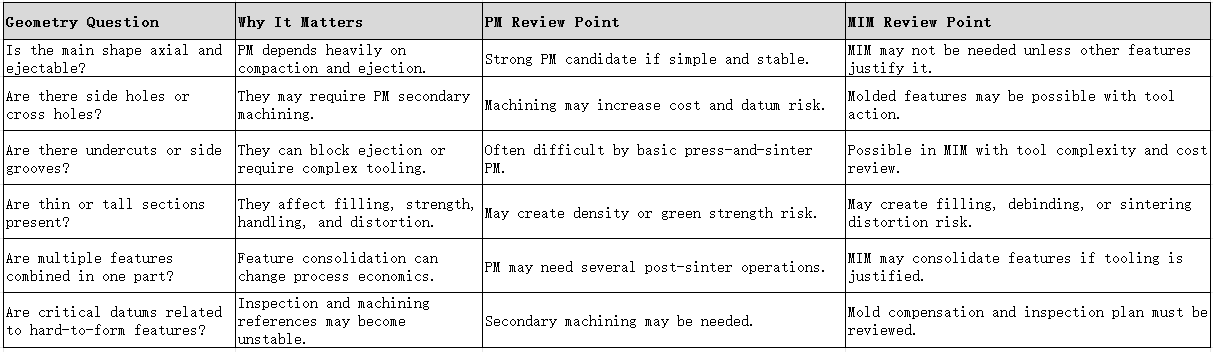
Geometry is usually the most important early decision factor. If a part can be compacted, supported, ejected, sintered and finished efficiently by conventional PM, PM may remain the better route. If the geometry fights the compaction direction or creates too much secondary machining, MIM may deserve earlier review.
For PM, the pressing direction defines what can be formed directly. Holes along the pressing direction can often be formed with core rods, but side holes, cross holes, transverse slots, external undercuts and features that block ejection usually require machining, redesign or more complex tooling.
For MIM, the geometry window is wider, but not unlimited. MIM can form complex three-dimensional features, but those features still need mold release, gate design, balanced filling, debinding access, shrinkage control and sintering support. Added tooling elements such as slides and cores can increase complexity, but they add tooling and start-up engineering cost.
When a New Part Should Be Reviewed as PM First
PM should often be reviewed first when the part geometry is relatively regular, the main features follow the pressing direction, and the functional requirements can be met with controlled density, controlled porosity, sizing, coining, oil impregnation or limited secondary machining.
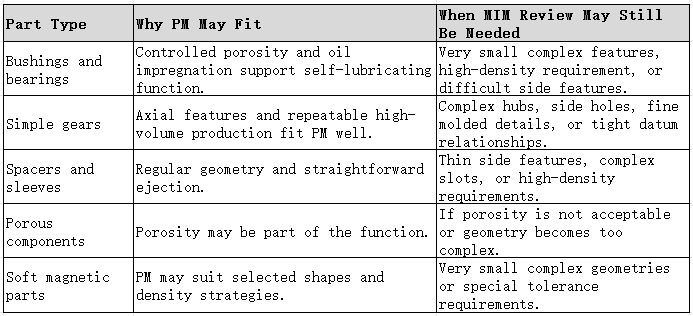
PM is not a lower-grade route. For bushings, bearings, simple gears, sleeves, porous parts and oil-impregnated components, it may be the correct engineering route rather than a compromise.
PM-first review is usually reasonable when:
The part can be pressed along a clear vertical axis.
Side holes, side grooves and undercuts are absent or not function-critical.
The part can be ejected without damaging thin walls, flanges or punches.
The required density and porosity fit PM material design.
Oil retention, self-lubrication or porous function is useful.
The production volume is stable and the design is cost-sensitive.
Sizing, coining or limited machining can control the key dimensions.
PM should not be rejected just because MIM can achieve higher density or more complex shapes. If PM meets the functional requirement with lower process risk and fewer unnecessary operations, it may be the better choice.
MIM should be reviewed first when the part is small, complex and difficult to produce efficiently by axial powder compaction. The strongest MIM candidates are usually parts where geometry, feature integration or reduced secondary operations justify the extra process steps of molding, debinding, sintering and shrinkage control.
MIM-first review is usually reasonable when:
The part includes side features, undercuts, slots, fine teeth, small bosses or internal details.
The design would require multiple PM secondary machining operations.
The part can consolidate several machined, stamped or assembled pieces into one molded metal component.
High density or lower porosity is important for strength, toughness, sealing or functional loading.
The part is small enough for MIM economics to be practical.
The annual volume can support tooling and process development.
The design is still flexible enough to optimize gate location, wall thickness, radii and sintering support.
MIM allows part design freedom similar to plastic injection molding while producing a metal component, and complexity can support combining multiple components or molding functional features from the start.
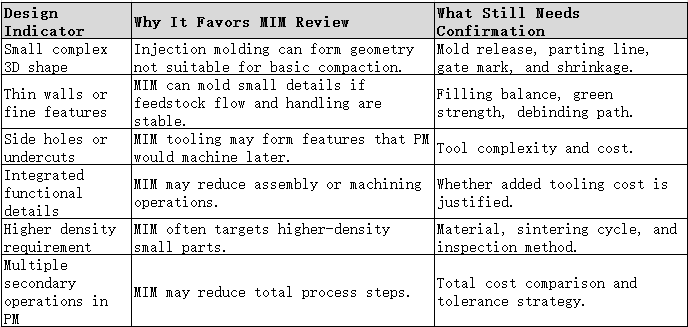
When MIM Should Not Be the First Choice
MIM should not be selected only because it can form complex metal parts. It may not be the first choice when the part is large and simple, the annual volume is too low to justify tooling, the geometry is already PM-friendly, the function requires controlled porosity or oil impregnation, or the drawing can be produced more directly by conventional PM with sizing, coining or limited machining.
Density should not be treated as a simple "higher is always better" comparison. In some projects, high density and low porosity are essential. In other projects, controlled porosity is part of the function.
MIM often targets higher-density small components where strength, toughness, corrosion performance, sealing, magnetic behavior or fine functional features matter. If conventional pressing and sintering can produce the shape, MIM is often too expensive.
PM may intentionally use porosity for oil retention, self-lubrication, filtration, sound damping or controlled density. For bushings, bearings, porous components and some friction or lubrication-related parts, porosity may be an engineering feature rather than a defect.
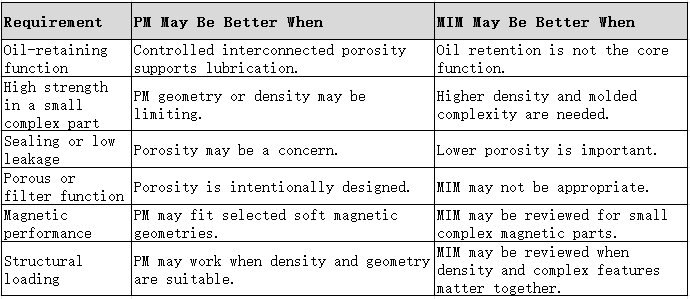
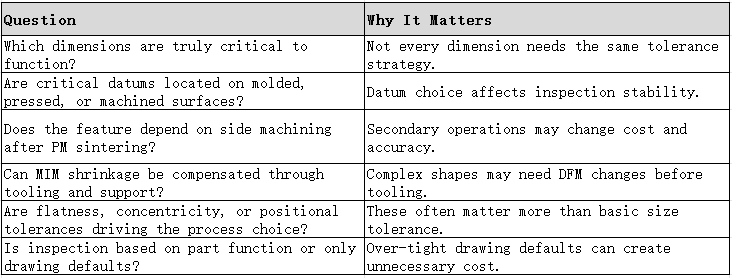
Tolerance Strategy: Shrinkage Control vs Sizing and Coining
Tolerance comparison between MIM and PM should not be reduced to "which process is more precise." The real question is where the dimensional risk comes from and how the process controls it.
In MIM, dimensional control depends on feedstock behavior, mold design, gate location, debinding stability, sintering shrinkage, part support and inspection planning. Because the molded green part contains binder and shrinks during sintering, tooling compensation and sintering control are central to the dimensional strategy.
In PM, dimensional control depends on powder filling, compaction uniformity, green strength, ejection, sintering change, die wear and secondary operations such as sizing, coining, repressing or machining. PM can be efficient when key dimensions are aligned with the process window, but complex datum relationships may create additional inspection and finishing risk.
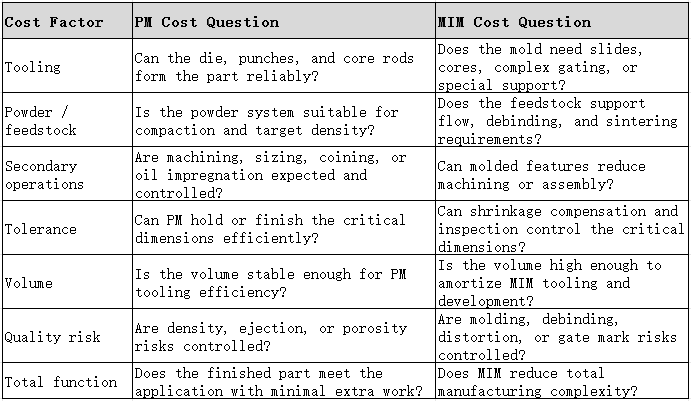
Cost Logic: Compare Functional Part Cost, Not Only Unit Price
For new metal parts, cost comparison should be based on the finished functional part, not only the formed blank.
PM can be more economical when the compacted and sintered part already satisfies most of the function with limited secondary processing. MIM may be justified when the geometry is complex enough to reduce machining, assembly, welding or multiple feature-specific operations.
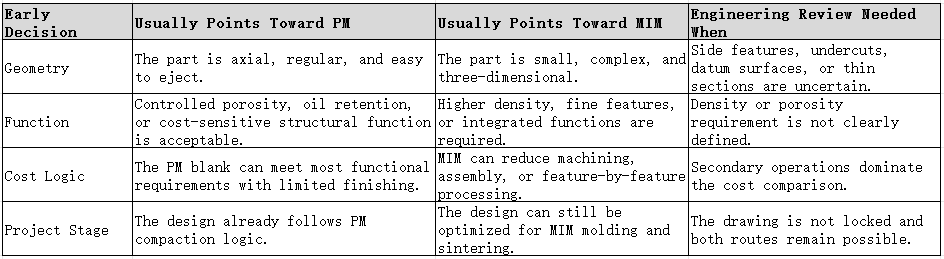
Early Selection Matrix: PM First, MIM First, or Engineering Review Needed
The following matrix is the most practical way to use this guide during early design review. It is a screening tool, not a final manufacturing decision. It helps decide which route should be evaluated first and what information should be clarified before tooling or RFQ.
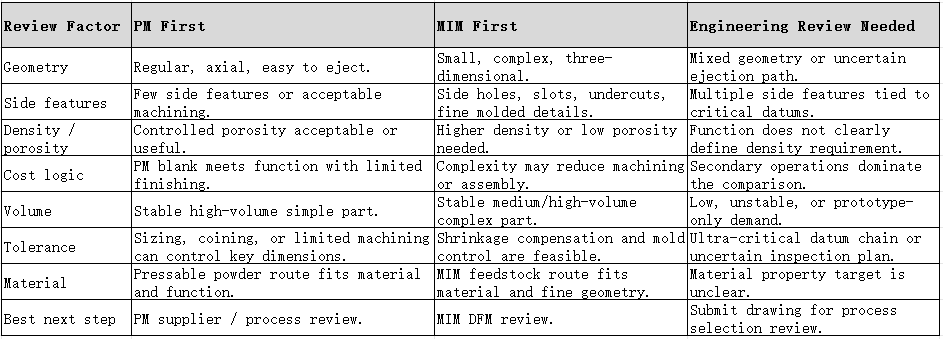
Engineering review trigger: If two or more rows fall into "Engineering Review Needed," submit the drawing before selecting PM tooling or MIM tooling — especially when the part has side holes, undercuts, uncertain density or porosity requirements, multiple critical datums, or an unconfirmed production volume.
Mistake 1 — Choosing by material name before reviewing geometry. Material selection is important, but geometry controls the forming route. A part may still be unsuitable for one route if the shape cannot be compacted, ejected, molded, debound or sintered reliably.
Mistake 2 — Assuming MIM is an upgrade from PM. MIM is not a universal upgrade. PM may be better when the part is pressable, cost-sensitive, high-volume, and can benefit from controlled porosity or straightforward secondary finishing.
Mistake 3 — Assuming PM is always cheaper. PM is often economical for simple pressable parts, but it may lose cost advantage if the part requires multiple side holes, tight machined datums, complex finishing or repeated design compromise. Compare at the finished-part level.
Mistake 4 — Ignoring functional porosity. Porosity can be a risk in one part and a functional feature in another. A sealed high-strength component may favor MIM review, while an oil-impregnated bearing may favor PM.
Mistake 5 — Reviewing process selection after tooling is already fixed. Once tooling direction is locked, design changes become slower and more expensive. Early selection should happen before finalizing parting logic, pressing direction, gate location, datum scheme and critical tolerance assumptions.
Scenario A — A side-hole component initially reviewed as PM. A small metal component looked simple in the front view, so the buyer initially expected a PM route. During drawing review, several side holes and a functional slot were found to be tied to assembly datums. The early process discussion had focused on material and projected annual volume, not forming direction. The real cause was not that PM was a poor process — it was that the geometry did not match the basic press-and-sinter forming route, so the cost driver became secondary machining and datum control. The design was then reviewed as a possible MIM candidate, comparing PM blank cost plus side machining against MIM tooling, molded feature feasibility, gate location, wall balance, sintering support and final inspection. For new parts, review pressing direction, side features, datum relationships and secondary machining load before assuming PM is the lowest-cost route.
Scenario B — A bushing design that should stay PM-first. A buyer asked whether a small sleeve-like part should be reviewed for MIM because it was made from metal powder and required repeatable production. The buyer associated MIM with "higher density" and assumed that would automatically improve the part. But the part function depended on controlled porosity and oil-retaining behavior, and the geometry was regular, axial and suitable for compaction and ejection. The project remained PM-first, focusing on powder selection, density target, porosity control, oil impregnation, sizing requirements and inspection of functional dimensions. Do not treat density as a universal ranking factor — first confirm whether porosity is a defect, a neutral characteristic, or part of the intended function.
Creative promotion copy: Many engineers start from the alloy name and ask "can this material be MIM or PM?", then lock tooling direction before checking whether the shape can actually be pressed, ejected, molded, debound or sintered reliably. You don't need to gamble on the wrong process route for your new metal part. Send your 2D/3D drawings, material requirements, volume forecast and density or porosity needs to Harbermetal. Our engineering team runs a drawing-based process selection review — telling you honestly whether your part should be evaluated as PM-first, MIM-first, or hybrid — before you invest in any tooling.
Harbermetal is an ISO-certified full-chain China custom MIM services supplier — a real manufacturer, not a trading intermediary. We support both powder-metallurgy forming routes: full MIM (feedstock evaluation, custom mold development, injection molding, multi-stage debinding, vacuum sintering, heat treatment, secondary CNC sizing and surface finishing) and conventional press-and-sinter PM capability for regular, pressable parts.
Our engineering team reviews every new drawing against geometry, pressing direction, ejection, molded-feature feasibility, density and porosity requirements, tolerance strategy, secondary operations and volume. We produce custom components in stainless steel (304L, 316L, 17-4PH, 420, 440C), low-alloy steel, bronze, soft-magnetic alloys, titanium and nickel-base alloys for automotive hardware, power-tool components, lock systems, consumer electronics, wearable devices and non-implant medical auxiliary projects. We provide first-article inspection reports, density/hardness/metallographic test records and full batch-traceability documentation from prototype sampling to high-volume serial production.
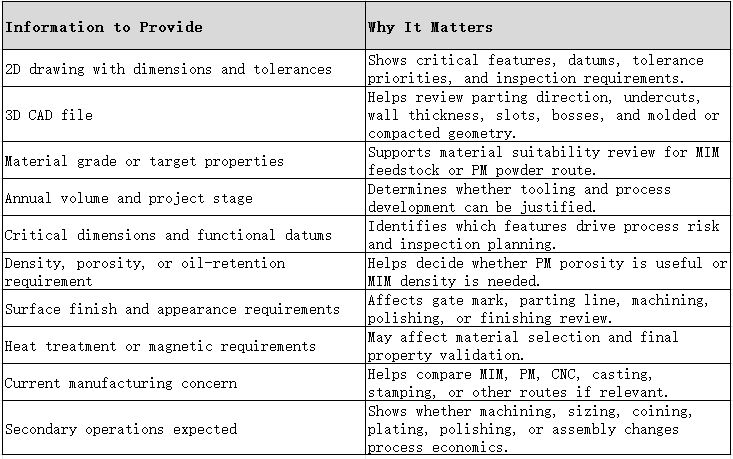
A useful process recommendation requires more than a part name. The review should be based on drawing geometry, function, tolerance priorities, material requirements, density or porosity expectations, production volume and secondary operations.
Final Selection Rule
Start with geometry and function. If the part is axial, regular, pressable, ejectable, cost-sensitive and can use controlled porosity, PM may be the better first review route. If the part is small, complex, three-dimensional, difficult to compact, or requires higher density with molded fine features, MIM should be reviewed first.
Do not treat density as a universal ranking factor, and do not assume MIM is an automatic upgrade or PM is always cheaper. Compare the finished functional part cost, review porosity as a function rather than a defect, and complete process selection before tooling direction is fixed.
Contact informationEmail: sales@harber-mim.comTel: +86 0769-82389116
Should a new metal part be designed for MIM or PM first?Start with geometry and function. If the part is axial, regular, pressable, ejectable, cost-sensitive and can use controlled porosity, PM may be the better first review route. If the part is small, complex, three-dimensional, difficult to compact, or requires higher density with molded fine features, MIM should be reviewed first.
Is MIM better than PM for complex metal parts?MIM is often better for small complex metal parts with side features, undercuts, thin walls, fine details or integrated functions. But MIM is not automatically better for every powder-metal component. If the shape can be produced efficiently by conventional pressing and sintering, PM may remain more practical.
When is PM a better choice than MIM?PM is often better when the part has a regular pressable shape, clear ejection path, stable high-volume demand, cost-sensitive requirements, and functional use for controlled porosity or oil impregnation. Common examples include bushings, bearings, sleeves, simple gears, spacers and selected porous or structural parts.
When should MIM not be used instead of PM?MIM should not be used only because it can make metal parts. It may not be the first choice when the part is large and simple, the volume is too low for tooling, the design already fits PM compaction, or the function requires controlled porosity or oil impregnation.
Does higher density always mean MIM is the better process?No. Higher density can be important for strength, toughness, sealing or certain precision functions, but some PM parts intentionally use porosity for lubrication, permeability or density control. The correct choice depends on the part function, not density alone.
Is PM always cheaper than MIM?PM is often more economical for simple, pressable, high-volume parts. MIM may become more cost-effective when complex geometry reduces machining, assembly, welding or multiple secondary operations. Compare the finished functional part cost, not only the formed blank price.
What information is needed for a MIM or PM process review?Send a 2D drawing, 3D CAD file if available, material requirement, annual volume, critical dimensions, tolerance notes, density or porosity requirement, surface finish, heat treatment needs, application environment and expected secondary operations.
Can one drawing be reviewed for both MIM and PM?Yes. A useful early review should compare forming feasibility, pressing direction, ejection, molded-feature risk, density or porosity needs, tolerance strategy, secondary operations, material suitability and production volume before recommending MIM, PM or another manufacturing route.
Ready to determine whether your new metal part should be reviewed as PM-first, MIM-first, or engineering-review-needed? Submit your drawings and functional specifications for a free process selection review and transparent quotation.
Request A Free Quote

Save money - with manufacturer direct pricing
Save time - with experienced team to get project done
Lead the industry - with the most cutting-edge products
 Send A Message
If you are interested in our products and want to know more details,please leave a message here,we will reply you as soon as we can.
 English